
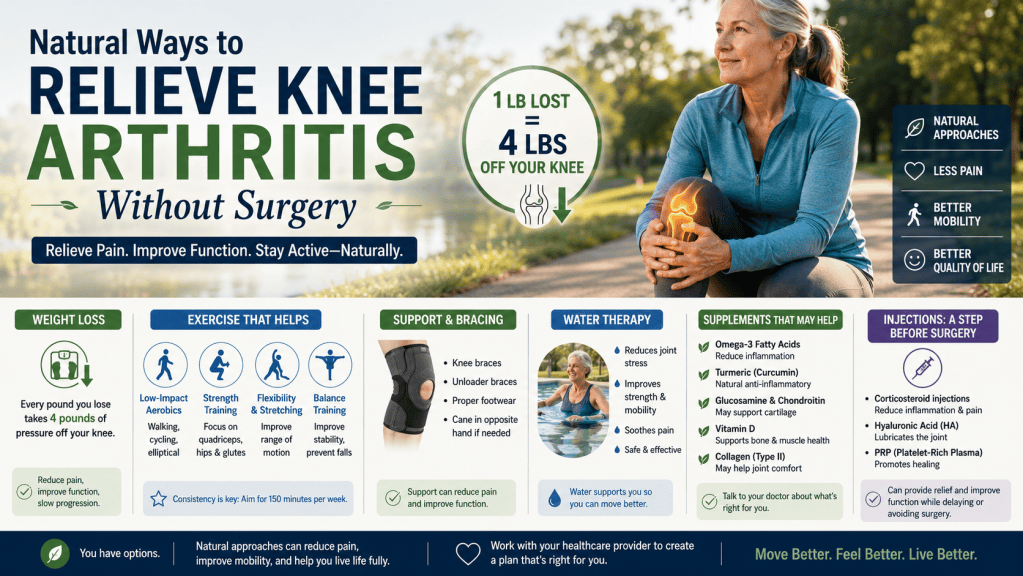
TLDR
If you have knee arthritis, the right exercise is one of the most effective things you can do, and the instinct to rest a painful knee usually backfires. Low-impact activities let you stay active without pounding the joint, and the best options include swimming, water aerobics, cycling, and walking on level ground, along with strengthening the muscles around the knee, especially the quadriceps. Movement helps because it keeps the joint lubricated, nourishes cartilage, and builds the muscle support that offloads the knee, whereas inactivity weakens that support and makes pain worse over time. The activities to be cautious with are the high-impact, high-twist ones like running on hard surfaces and deep or jarring movements. You do not have to give up the activities you enjoy, but you may need to modify them. If exercise consistently causes sharp or lasting knee pain, that is a signal to get guidance rather than push through.
Why Moving Is Better Than Resting
When your knee hurts, resting it feels like common sense. It is also, for arthritis, usually the wrong long-term move.
Here is the loop that catches people. A painful knee leads you to move less. Moving less weakens the muscles that support and stabilize the knee, particularly the big quadriceps muscles on the front of your thigh. Weaker muscles mean less support for the joint, which leads to more pain, which leads to even less movement. Round and round it goes, and your knee gets steadily worse while you are trying to protect it.
Appropriate exercise breaks that cycle. It is one of the best-supported treatments for knee osteoarthritis, and the benefits are real: less pain, better function, and a joint that is better supported and more resilient. The key qualifier is appropriate. The goal is to load the muscles that protect the knee without hammering the joint itself, and that is exactly what low-impact exercise is designed to do. You can read more about the role of exercise in managing arthritis through the Arthritis Foundation.
How Movement Actually Helps the Joint
It helps to understand why movement is protective, because it makes the advice easier to trust when your knee is sore.
Your cartilage, the smooth cushioning tissue in the joint, does not have its own direct blood supply. It relies on movement to stay healthy. When you move the joint, it draws in the joint fluid that nourishes and lubricates the cartilage, a bit like a sponge soaking up and releasing water. Gentle, regular movement keeps this process going. Prolonged stillness, by contrast, leaves the joint stiff and poorly nourished.
On top of that, exercise builds the muscle support around the knee. Strong quadriceps, hamstrings, and hip muscles absorb load and stabilize the joint, taking pressure off the worn surfaces. In effect, you are building a better support system around the arthritis. This combination, better-nourished cartilage and stronger surrounding muscle, is why movement so often reduces arthritis pain rather than aggravating it, as long as it is the right kind.
The Best Low-Impact Exercises for Knee Arthritis
These options give you the benefits of movement while sparing the joint the pounding that high-impact activity delivers.
Swimming and water aerobics. Water is arguably the ideal environment for arthritic knees. The buoyancy supports most of your body weight, dramatically reducing the load on the joint while you move, and the water provides gentle resistance that strengthens muscles. For someone whose knee hurts too much to exercise comfortably on land, water is often the way back in. Warm-water pools have the added benefit of easing stiffness.
Cycling. Whether on a stationary bike or outdoors on flat terrain, cycling moves the knee through its range of motion and builds the quadriceps without any impact at all, since your feet never strike the ground. Keep the resistance moderate and the seat height correct so your knee is not overly bent, and it is one of the most joint-friendly ways to get real exercise.
Walking on level ground. Walking is accessible, free, and genuinely useful, provided you stick to flat, even surfaces and supportive footwear. Start with short distances and build gradually. Level ground matters, since hills and uneven terrain add stress the arthritic knee may not tolerate well early on.
Elliptical training. An elliptical machine offers a cardio workout with a smooth, gliding motion that avoids the impact of running, making it a reasonable middle ground for many people.
Strengthening exercises. Targeted strengthening is essential, not optional. Movements that build the quadriceps, hamstrings, and hip muscles directly improve the support around the knee. Straight-leg raises, gentle squats within a comfortable range, and similar exercises, ideally guided by a professional at first, pay off substantially. Strengthening the muscles is often what produces the most lasting reduction in pain.
What to Be Cautious About
Not all exercise is equal for an arthritic knee, and a few activities tend to aggravate rather than help, especially if the arthritis is more advanced.
Generally, approach the following with care:
- Running or jogging on hard surfaces, which delivers repeated high impact to the joint
- Deep squats and deep lunges, which load the knee heavily in a bent position
- High-impact sports with jumping, sudden stops, and pivoting, like basketball or singles tennis
- Any activity that consistently produces sharp or lasting knee pain
This does not mean these are universally forbidden for everyone with knee arthritis, since severity varies and some people tolerate more than others. But they carry more risk of aggravating the joint, and they are not the place to start. When in doubt, favor the smooth, controlled, low-impact options over the jarring, high-twist ones.
A useful rule of thumb: some mild discomfort or achiness during and shortly after exercise is common and usually fine, but sharp pain, or pain that lingers and worsens for a day or more afterward, means you did too much or the wrong thing. That is feedback to adjust, not a reason to quit entirely.
Modifying the Activities You Love
You do not necessarily have to abandon the activities that matter to you. Often you can modify them to be kinder to your knees while still enjoying them.
A runner might shift some mileage to cycling or pool running to cut the total impact. A tennis player might move toward doubles, with less court to cover and less sprinting. A hiker might choose flatter, smoother trails, use trekking poles to offload the knees, and avoid steep descents, which are especially hard on the joint. Someone who loves group fitness classes might pick low-impact formats over high-intensity jumping ones.
The principle is to keep the parts you love while reducing the impact and the deep, twisting loads. A creative modification usually beats giving something up entirely, both for your knee and for your motivation to stay active, and a physical therapist or specialist can often suggest adjustments specific to your activity and your knee.
Getting Started Safely
If you are largely inactive right now or your knee pain is significant, a few principles keep the return to movement from backfiring.
Start smaller than you think you should and build up gradually, giving your body time to adapt. Warm up gently before and ease off rather than stopping abruptly. Consistency matters more than intensity, so a moderate amount most days beats occasional hard sessions that leave you sore for a week. And pay attention to how your knee responds over the following day, adjusting based on that feedback.
Getting professional guidance early is genuinely worthwhile, especially if you are unsure what your knee can handle. A physical therapist can build a program matched to your specific arthritis and teach you proper form, which both maximizes the benefit and reduces the risk of aggravating the joint. This is part of what a comprehensive arthritis care plan looks like, and it sets you up to succeed rather than guessing on your own.
When Exercise Alone Isn’t Enough
Exercise is powerful, but knee arthritis sometimes needs more support, and there is no failure in that.
If knee pain is consistently preventing you from exercising at all, if the joint is too painful or stiff to get started despite your best efforts, or if you are stuck in that cycle where the pain will not let you build the strength that would ease the pain, that is where additional treatment comes in. Targeted knee injections can reduce pain and inflammation enough to open a window in which exercise finally becomes possible, and using that window to build strength is exactly how injections and movement work together.
This is often the missing piece for people who feel stuck: not choosing between exercise and treatment, but using treatment to make the exercise achievable, which in turn produces the lasting improvement.
Staying Active With Knee Arthritis in NYC
Knee arthritis does not mean the end of an active life. For most people, the right low-impact exercise, built up sensibly and matched to the joint, reduces pain and keeps them moving for years. Movement, it turns out, is medicine for the arthritic knee, as long as it is the right kind.
Our pain management team can help you find that right kind, combining guidance on safe, effective exercise with treatments like injections when they are needed to make movement possible in the first place.
If knee arthritis is making it hard to stay active, reach out to schedule a consultation and build a plan that keeps you moving without making the joint worse.