
TLDR
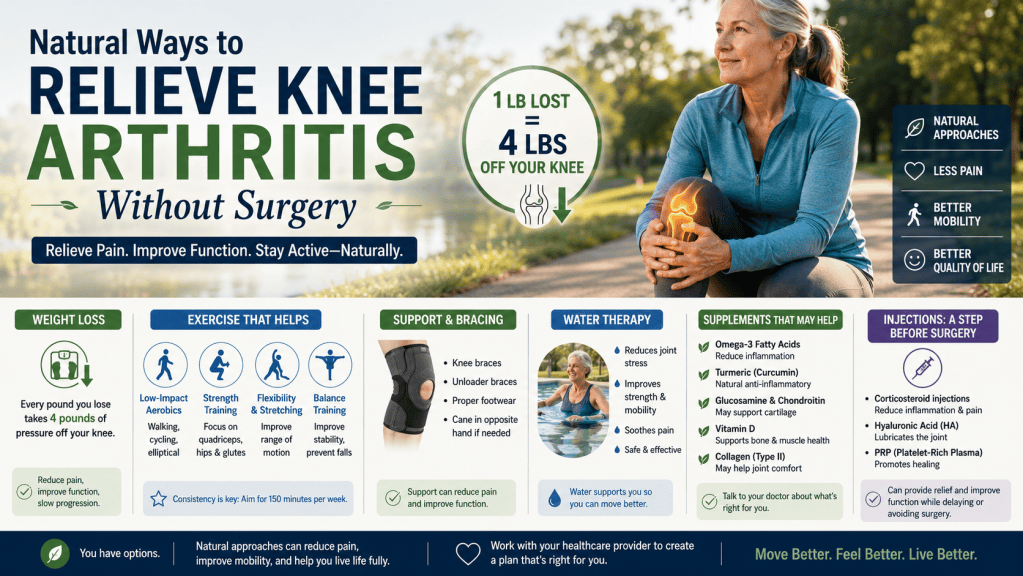
Most knee arthritis can be managed for years without surgery, and the non-surgical options are more effective than many people expect. Losing even a small amount of weight meaningfully reduces the load on your knees, since the force through the joint when you walk is several times your body weight. Low-impact exercise strengthens the muscles that support the knee and is one of the best-proven treatments for osteoarthritis, even though moving a painful knee feels counterintuitive. Braces, water-based therapy, and activity adjustments all help you stay active with less pain. When these are not enough, injections can provide targeted relief and are often used as a step before surgery is ever considered. Surgery is not the automatic next stop for knee arthritis. It is usually the last resort, after a full non-surgical plan has been given a real chance.
Surgery Is Not the Only Answer, and Usually Not the First
When knee arthritis pain sets in, a lot of people quietly assume they are on a conveyor belt toward a knee replacement. That assumption causes real harm, because it makes people either rush toward surgery they may not need or avoid seeking help at all out of fear of where it leads.
Here is the reality. Knee osteoarthritis, the common wear-related form of arthritis, is usually managed successfully for years without any surgery at all. A well-built non-surgical plan can reduce pain, improve how well your knee works, and in many cases delay or entirely avoid an operation. Surgery has its place, but it sits at the end of the process, not the beginning.
Let us go through what actually works, roughly in order of how much leverage it gives you.
Weight Management: The Single Biggest Lever
This is not the fun one to hear, but it is the one with the most impact, so it goes first.
Your knees carry your body weight with every step, and the force traveling through the joint while walking is several times your actual weight because of how the joint mechanics work. This multiplier is why even modest weight loss produces an outsized reduction in the load your knees absorb, and it is why losing a relatively small amount can translate into a much larger drop in the force going through the joint with each stride.
That mechanical relief tends to show up as less pain and less day-to-day irritation of an already-worn joint. You do not need to reach an ideal weight to feel a difference. Studies of osteoarthritis consistently find that even a modest percentage of weight loss meaningfully improves knee pain and function. It is one of the highest-return things you can do, and it makes every other treatment on this list work better.
If weight loss has been a struggle, it is worth getting real support rather than white-knuckling it. Working with a professional on nutrition can make the difference between a diet that fizzles and a sustainable change your knees will feel.
Exercise: The Treatment That Feels Wrong but Works
The instinct with a painful knee is to rest it and move it as little as possible. For arthritis, that instinct usually backfires. Inactivity weakens the muscles around the knee, and weaker muscles mean less support for the joint and more pain, which leads to more inactivity. It is a downward spiral.
Appropriate exercise is one of the best-supported treatments for knee osteoarthritis. The goal is to strengthen the muscles that stabilize and offload the knee, especially the quadriceps, while keeping the joint mobile, without pounding it.
Good options include:
- Strengthening for the thigh and hip muscles that support the knee
- Low-impact cardio such as cycling, using an elliptical, or walking on level ground
- Range-of-motion work to keep the joint from stiffening
- Balance training to protect the knee during everyday movement
The key phrase is low-impact. You are trying to load the muscles without hammering the joint, which is why running on pavement or deep, heavy squats are usually not the right starting point. A physical therapist can build a program matched to your knee, which is far better than guessing, especially early on when doing the wrong movement can flare things up and scare you off exercise altogether.
Water Therapy: Movement Without the Load
If land-based exercise is too painful to start, water is often the answer, and it deserves its own mention.
Exercising in a pool lets you move and strengthen while the water supports much of your body weight, dramatically reducing the load on your knees during the workout. For someone whose knee hurts too much to walk comfortably, water therapy can be the on-ramp that makes movement possible again. The warmth of a therapy pool also tends to ease stiff, achy joints, making it easier to move through a fuller range.
Aquatic therapy and simple pool walking are both worth asking about, particularly if your arthritis is advanced enough that starting on land feels impossible.
Braces and Supports
The right brace can meaningfully reduce pain for some people with knee arthritis, particularly when the arthritis is worse on one side of the joint than the other.
Certain braces are designed to gently shift load away from the more worn part of the knee, relieving pressure where it hurts most. Others simply provide stability and confidence, which helps you stay active without the knee feeling like it might buckle. Braces are not a cure and they are not right for everyone, but as a low-risk, non-invasive tool, they are worth discussing with a specialist who can tell you whether your particular pattern of arthritis is likely to benefit.
Activity Adjustments and Everyday Tools
Small changes to how you move through your day add up.
Swapping high-impact activities for low-impact ones protects the joint while keeping you active. Using a cane, correctly fitted and held in the opposite hand from the painful knee, can offload the joint more than people expect. Supportive, cushioned footwear reduces the jolt that travels up into the knee with each step. Heat before activity can loosen a stiff joint, and cold afterward can calm swelling.
None of these is dramatic on its own. Together, they help you keep living your life while asking less of a worn joint.
Supplements: A Measured Word
Supplements come up constantly with arthritis, so it is worth being straight about them.
Some people report benefit from certain over-the-counter supplements marketed for joint health, but the scientific evidence is mixed, and results vary a lot from person to person. They are generally low-risk for most people, which is different from being proven effective. If you want to try one, it is reasonable to do so, but check with your doctor first, especially if you take other medications, and do not let a supplement substitute for the approaches that actually have strong evidence behind them, like weight management and exercise. Think of them as a possible minor add-on, not a foundation.
Injections: Targeted Relief Before Surgery
When the foundational measures are not enough on their own, injections are often the next step, and importantly, they typically come well before any conversation about surgery.
Injections deliver treatment directly into or around the joint, targeting your pain at its source rather than dulling it throughout your whole body. Depending on your situation, several types of knee injections may be appropriate, and a specialist can explain which fits your specific arthritis and goals. For many patients, injections provide a meaningful window of relief that makes it far easier to exercise, lose weight, and stay active, which in turn slows the whole cycle down.
This is exactly the kind of role a dedicated pain practice plays: offering targeted, minimally invasive options that extend the non-surgical runway, sometimes for years, and often making surgery unnecessary. If you want to understand how injections fit into a broader plan, our arthritis care and overall pain management approach are built around getting you relief without jumping to the operating room.
Do Not Overlook the Mental Load
Living with a painful, limiting joint wears on you, and that is worth naming. Chronic knee pain can shrink the activities you enjoy, disrupt sleep, and grind down your mood, and low mood and stress genuinely amplify how pain is experienced.
Addressing this side is not a sign of weakness or an admission that the pain is imagined. It is part of good care. Support through behavioral health services can help you cope with the frustration of arthritis, stay motivated through an exercise and weight program, and break the pain-stress-inactivity loop that otherwise feeds on itself.
When to See a Specialist
You do not need to wait until your knee is unbearable to get help. In fact, the earlier you build a real non-surgical plan, the more runway you have before surgery ever enters the picture.
It is worth seeing a specialist if knee pain is limiting your daily activities, if over-the-counter measures are no longer cutting it, if the pain is disrupting your sleep, or if you have simply been told surgery is your only option and want to know whether that is actually true yet. Often it is not.
Getting a Real Non-Surgical Plan in NYC
Knee arthritis is not a straight line to a replacement. For most people, a thoughtful combination of weight management, the right exercise, supportive tools, and well-timed injections controls pain and preserves function for a long time, frequently making surgery something you delay for years or avoid altogether.
Our pain management team builds exactly these kinds of plans, targeting your knee pain at its source and keeping you moving without rushing you toward the operating room.
If knee arthritis is slowing you down, reach out to schedule a consultation and find out how much can be done before surgery is ever on the table.