
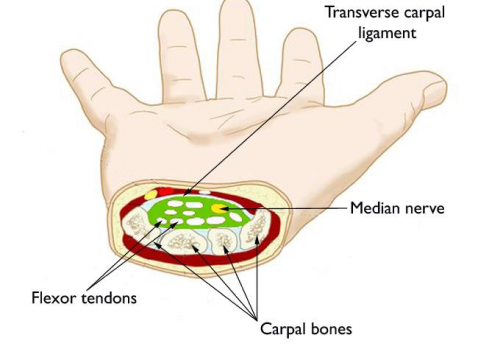
Causes of Carpal Tunnel
Carpal tunnel syndrome can result from several combined factors:
-
Repetitive hand use: Long periods of repeated hand and wrist motions can irritate tendons, causing swelling and pressure on the nerve.
-
Hand and wrist position: Working with the wrist bent or in extreme positions increases nerve pressure.
-
Pregnancy: Hormonal changes may lead to swelling that compresses the nerve.
-
Associated health conditions: Diabetes, rheumatoid arthritis, osteoarthritis, thyroid disorders, and obesity can raise risk.
Symptoms of Carpal Tunnel Syndrome
Symptoms often start gradually and worsen over time. They may come and go at first, then persist longer as the condition advances:
-
Numbness, tingling, burning, or pain in the thumb, index, middle, and ring fingers—often waking people at night.
-
Shock-like sensations radiating to these fingers.
-
Pain or tingling traveling up the forearm toward the shoulder.
-
Hand weakness or clumsiness that makes gripping or fine movements difficult and may cause dropping objects.
Diagnosis of Carpal Tunnel Syndrome
Diagnosis combines a detailed history, physical exam, and sometimes nerve testing:
-
Medical history: Review of symptoms, related health issues, and activities.
-
Physical exam: Tests such as Tinel’s sign (tapping the median nerve), Phalen’s maneuver (bending wrists), sensory checks, and thumb strength evaluation.
-
Diagnostic studies:
-
Nerve conduction studies to measure how signals travel along the median nerve.
-
Electromyogram (EMG) to detect muscle or nerve damage.
-
X-ray or MRI to rule out arthritis, fractures, or structural issues.
-
Treatment of Carpal Tunnel Syndrome
Treatment depends on severity and how long symptoms have been present.
Conservative options
-
Medications: Nonsteroidal anti-inflammatory drugs (NSAIDs) or acetaminophen for pain and swelling.
-
Bracing or splinting: Wearing a brace—especially at night—keeps the wrist neutral and reduces pressure.
-
Activity modification: Changing daily or work tasks that trigger symptoms helps slow or stop progression.
Surgical option
-
Carpal tunnel release: Cutting the transverse carpal ligament (open or endoscopic surgery) enlarges the tunnel and relieves pressure, restoring nerve blood flow and function.
Pain medicine interventions
-
Nerve-gliding exercises to help the median nerve move freely.
-
Steroid or PRP injections to reduce inflammation and speed healing.
-
Physical therapy to improve strength and flexibility, especially after surgery.
Prognosis and Impact
Early diagnosis and treatment often relieve symptoms without surgery.
If nonsurgical care fails or symptoms worsen, surgery usually improves pain and function.
Untreated carpal tunnel syndrome can cause permanent nerve damage and thumb muscle weakness, reducing hand dexterity.
Recovery after surgery is generally good but may take up to a year.
Procedure Videos
Steroid injection
FAQ’s
1. What is carpal tunnel syndrome?
Carpal tunnel syndrome is a nerve compression problem in the wrist. It occurs when the median nerve is squeezed inside the carpal tunnel, leading to numbness, tingling, and pain in the hand and fingers.
2. What are the first signs of carpal tunnel syndrome?
Early symptoms often include night-time tingling, numbness, or burning in the thumb, index, and middle fingers. Some people notice occasional “electric shock” sensations or weakness when gripping objects.
3. How is carpal tunnel syndrome diagnosed?
Diagnosis starts with a physical exam and medical history. Tests such as Tinel’s sign, Phalen’s maneuver, nerve conduction studies, or an EMG confirm how well the median nerve is working and rule out other conditions.
4. What treatments are available for carpal tunnel syndrome?
Mild cases often improve with wrist splints, activity changes, and anti-inflammatory medication. If symptoms persist, steroid or platelet-rich plasma injections and carpal tunnel release surgery may be recommended to relieve pressure on the nerve.
5. Can carpal tunnel syndrome go away without surgery?
Yes—many mild cases improve with nonsurgical care when treated early. If symptoms continue or worsen despite bracing, therapy, and lifestyle changes, surgery may be needed to prevent permanent nerve damage.
Resources:
https://orthoinfo.aaos.org/en/diseases–conditions/carpal-tunnel-syndrome/