
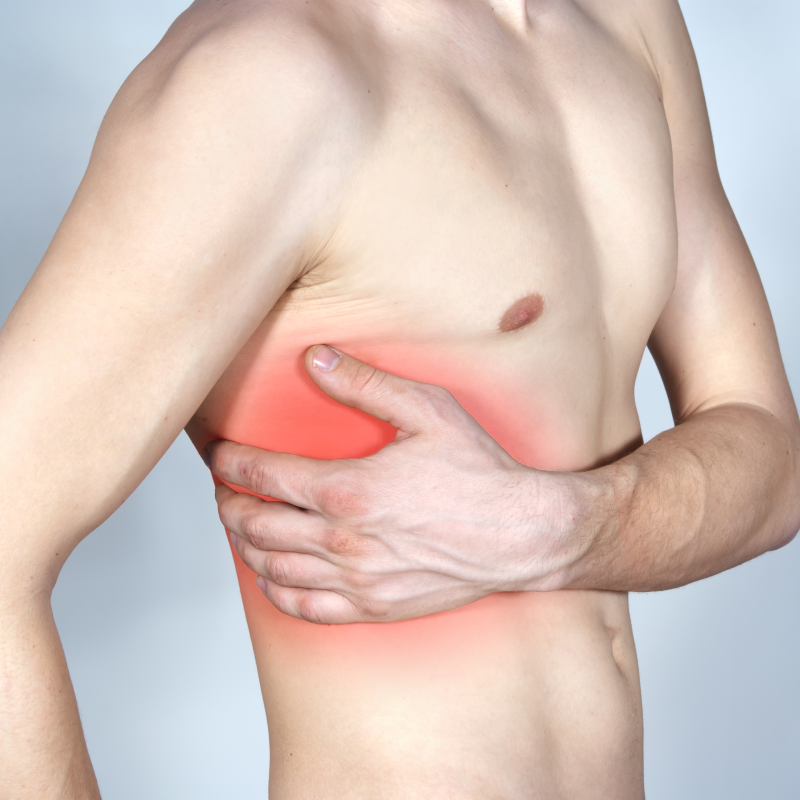
Causes of Chest and Rib Pain
Chest and rib pain can caused by a wide variety of conditions, and the pain may present differently based on the cause and involved structures:
Costochondritis: Inflammation of the cartilage connecting the ribs to the sternum/breastbone.
Muscle Strain: A strain in a muscle of the chest wall can result from overuse, impact or trauma, or sudden movements.
Gastroesophageal / Acid Reflux: Occurs when stomach acid refluxes from the stomach into the esophagus, typically due to an incompetency of the lower esophageal sphincter that separates the stomach from the esophagus.
Pleurisy / Pleuritis: An inflammation of the lining of the lungs, also known as the pleura. The pleura may become inflamed for a number of reasons, including pneumonia or a blood clot in the lungs (pulmonary embolism).
Angina: Chest pain that occurs when the heart muscle is strained and does not receive an adequate supply of oxygen. This is due to blockage and disease of the blood vessels that supply the heart, and if left untreated may progress to a myocardial infarction or heart attack.
Trauma: Trauma to the anterior chest wall or rib cage can result in rib or sternal fractures, resulting in severe pain.
Symptoms of Chest and Rib Pain
The nature of the chest and rib pain, as well as the circumstances that provoke the pain, may vary based on the cause of the pain:
Costochondritis: The associated chest pain often worsens with movement, such as deep breaths, coughing, and stretching, and the area of inflammation is often tender to the touch.
Muscle strain: The associated pain is often worse with movement, such as with deep breathing, coughing, or sneezing. Muscle spasms or tenderness over the strained muscle may also occur.
Gastroesophageal reflux: The associated pain may be described as burning in the center of the chest, often worse after eating or lying down. Symptoms may improve following use of an antacid.
Pleuritis: The associated chest pain is often sharp and worsens with deep breathing or coughing. Pain may be alleviated by leaning forward. Other symptoms may be present depending on the underlying cause of the pleuritis, such as symptoms of infection or pneumonia or evidence of a blood clot in the lower limb.
Angina: The associated pain is commonly described as pressure, squeezing, tightness, or burning, and the pain may radiate to the neck, jaw, arms, or back. The pain worsens with activity and is improved with rest.
Costochondritis
Diagnosis of Chest and Rib Pain
Diagnosing chest and rib pain typically involves:
Medical History: Discussion of symptoms, past medical conditions, and any recent infections or injuries.
Physical Examination: Assessment of visible injuries or trauma, heart and lung sounds, and tenderness of the chest wall.
Diagnostic Imaging: A chest X-ray and ECG will often be obtained to rule out more serious causes of chest and rib pain, such as a myocardial infarction, pneumonia, or fractures.
Prognosis of Chest and Rib Pain
The prognosis of chest and rib pain is typically favorable, with most cases of costochondritis and muscle strain resolving within 3-4 weeks. However, more serious causes of chest and rib pain, such as pleuritis, angina, or trauma may have further complications if left untreated.
Treatment of Chest and Rib Pain
Treatment options depend on the underlying cause of the chest and rib pain. Options include:
Conservative Treatments: Non-surgical approaches include:
Medications: Such as nonsteroidal anti-inflammatory drugs (NSAIDs) or muscle relaxants for pain management in cases of costochondritis or muscle strain. Medications to reduce stomach acid production, such as histamine (H2) blockers or proton pump inhibitors, can reduce symptoms associated with gastroesophageal reflux.
Physical Therapy: Exercises and stretching may improve pain related to costochondritis.
Acupuncture or Chiropractic Care: Some patients find relief through alternative therapies.
Pain Medicine Intervention: When conservative measures are ineffective or symptoms worsen, more invasive pain interventions may be considered:
Steroid Injections: Targeted injections to reduce inflammation and alleviate pain.
Nerve Blocks: Targeted injections of local anesthetic near affected nerves to reduce pain.
Peripheral Nerve Stimulation: Electrodes are placed near affected peripheral nerves to interrupt pain signals to the brain.
Procedure Videos
Intercostal nerve block
Erector Spinae Block
Paravertebral Block
PNS
References
Costochondritis. Mayo Clinic. Published May 11, 2022. https://www.mayoclinic.org/diseases-conditions/costochondritis/symptoms-causes/syc-20371175. Accessed December 5, 2024
Schumann JA, Sood T, Parente JJ. Costochondritis. In: StatPearls. StatPearls Publishing; 2024.