
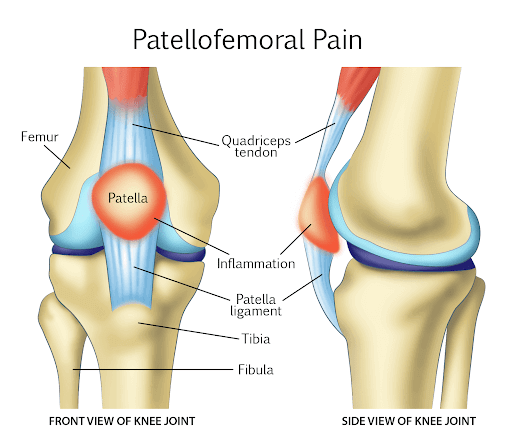
Causes of Knee Patellofemoral Pain Syndrome
Knee Patellofemoral Pain Syndrome can be caused by various factors, including:
Overuse: Repetitive activities that put stress on the knee joint can irritate the patellofemoral area. It is most common in runners, jumpers, and cyclers..
Improper Training Techniques: Sudden increases in the intensity or duration of physical activity or poor technique can contribute to knee patellofemoral pain syndrome.
Trauma: Previous knee injuries or accidents can contribute to the development of knee patellofemoral pain syndrome.
Congenital Factors: Some individuals may have poor alignment that affects how the patella tracks over the femur. These factors include: flat feet or overpronation, high arches, muscle imbalance or weakness, tight iliotibial band.
Symptoms of Knee Patellofemoral Pain Syndrome
The common symptom of knee patellofemoral pain syndrome is pain around or behind the kneecap. Symptoms may gradually develop and worsen over time. Other symptoms include:
- Pain with activities
- Pain after prolonged sitting
- Cracking or popping sensation
- Swelling
- Tenderness
- Difficulty with straightening knee
Impact of Knee Patellofemoral Pain Syndrome
Knee Patellofemoral Pain Syndrome can lead to several conditions:
- Patellar Tendinitis: The abnormal pressure placed on the patellar tendon causes damage and results in pain and tenderness just below the knee cap.
- Knee Osteoarthritis: Chronic inflammation and improper alignment leads to wear and tear of the knee joint causing osteoarthritis.
- Meniscal Tear: Altered knee tracking can increase stress on the knee joint causing meniscus injuries, especially when twisting the knee.
Diagnosis of Knee Patellofemoral Pain Syndrome
Diagnosing knee patellofemoral pain syndrome typically involves:
Medical History: Discussion of symptoms, past medical conditions, and any history of knee injuries.
Physical Examination: Assessment of reflexes, muscle strength, and sensation.
Diagnostic Imaging: X-rays to assess for fracture, CT scans or MRI scans to visualize soft tissue in the knee joint.
Treatment of Knee Patellofemoral Pain Syndrome
Treatment options include:
Conservative Treatments: Non-surgical approaches include:
Medications: Such as nonsteroidal anti-inflammatory drugs (NSAIDs) or muscle relaxants for pain management.
Physical Therapy: Exercises to strengthen muscles surrounding the knee and improve range of motion.
Rest and Activity Modification: Reducing or avoiding activities that worsen symptoms can alleviate inflammation and pain.
Bracing: Patellar bracing can improve patellar tracking and reduce pain.
Surgical Intervention: When conservative measures are ineffective or symptoms worsen, surgery may be considered:
Arthroscopy: Remove damaged cartilage and realign the patella..
Lateral Release: Cutting tight soft tissue around the patella so it can move along its track more freely.
Tibial Tubercle Transfer: Repositioning the attachment point for the patella can improve patellar alignment.
Prognosis: Patellofemoral pain syndrome has a good prognosis if treated properly. It was found that up to 90% of patients fully recover and resume normal activity. In a small amount of the patient population, symptoms can persist for years without activity modification.
Procedure Videos
Cortisone Injection
PRP
References
https://www.sports-health.com/video/treatment-knee-meniscus-tear-video
https://arizonapain.com/conditions/knee-pain-causes-and-treatments/
Bump JM, Lewis L. Patellofemoral Syndrome. [Updated 2023 Feb 13]. In: StatPearls [Internet]. Treasure Island (FL): StatPearls Publishing; 2024 Jan-. Available from: https://www.ncbi.nlm.nih.gov/books/NBK557657/