
TLDR
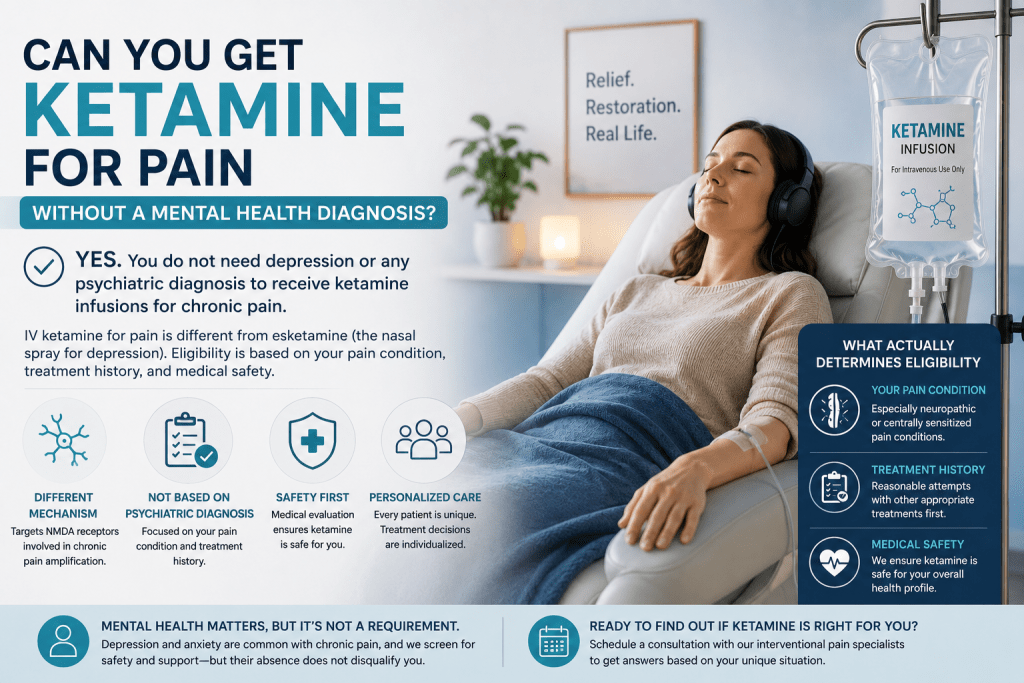
You do not need a mental health diagnosis to receive ketamine infusions for chronic pain. The confusion comes from esketamine, a nasal spray version of the medication that is FDA-approved specifically for treatment-resistant depression and does require a psychiatric diagnosis. IV ketamine used for chronic pain is a different formulation used for a different purpose, and it is prescribed based on your pain condition, your treatment history, and your medical safety profile. What actually determines eligibility is whether your pain is neuropathic or centrally sensitized, whether you have tried other appropriate treatments, and whether you have any conditions that make the infusion unsafe. Depression and anxiety are extremely common alongside chronic pain, and mentioning them helps your care team, but their absence does not disqualify you and their presence is not a requirement.
The Question, Answered Plainly
No. You do not need depression, anxiety, PTSD, or any psychiatric diagnosis to be treated with ketamine for chronic pain.
Patients ask this constantly, and a fair number of them have delayed calling a pain clinic for months because they assumed they were not eligible. Some have gone as far as considering whether they should mention low mood they do not actually have, just to qualify for something they were told might help.
You do not need to do that. Let us walk through where the misunderstanding started.
Where the Confusion Comes From
There are two related but distinct things in the world, and they get collapsed into one in most public conversation.
Esketamine is a nasal spray. The FDA approved it in 2019 specifically for treatment-resistant depression, and later for depression with acute suicidal ideation. Because it is FDA-approved for a psychiatric indication, receiving it does require a qualifying psychiatric diagnosis. It is administered under a restricted safety program at certified treatment centers.
IV ketamine is the intravenous form, delivered as an infusion. It has been FDA-approved as an anesthetic since 1970. When it is used for chronic pain, it is being used off-label, meaning it is being prescribed for something outside its formal approval.
Nearly all news coverage of ketamine over the past several years has been about the depression story, because that was the newsworthy part. Pain clinics have been using ketamine infusions for years without much press attention. So the public association became ketamine equals depression, and patients absorbed that association without knowing there was a second, older track.
What “Off-Label” Actually Means
This word makes people nervous, so it is worth explaining properly.
Off-label prescribing means a physician uses an approved medication for a condition, dose, or population outside the FDA’s specific approval. It is legal, it is common, and it is a normal part of medical practice across every specialty. A large share of prescriptions written in the United States each year are off-label.
Off-label does not mean experimental, unregulated, or evidence-free. Many off-label uses are supported by substantial published research. Ketamine for chronic pain is one of them. Consensus guidelines developed by anesthesiology and pain medicine societies specifically address its use in chronic pain and outline where the evidence is strongest.
What off-label does affect, practically, is insurance. Insurers often decline to cover ketamine infusions for pain. That is a billing reality, not a comment on whether the treatment is legitimate. Ask about cost during your consultation.
What Actually Determines Whether You Qualify
Eligibility for ketamine therapy in a pain setting comes down to three things.
Your pain condition. Ketamine works on NMDA receptors, which are involved in central sensitization, the process by which the nervous system amplifies and sustains pain signals over time. That mechanism means it tends to be more useful for neuropathic and centrally sensitized pain than for straightforward mechanical pain. The strongest evidence is in complex regional pain syndrome. Other conditions frequently considered include diabetic neuropathy, post-herpetic neuralgia, phantom limb pain, persistent post-surgical pain, and refractory pain in patients with substantial opioid tolerance.
Your treatment history. Physicians generally want to see that you have made reasonable attempts at lower-burden options first. Appropriate medications, physical therapy where your condition allows, and interventional treatments matched to your diagnosis.
Your medical safety profile. This is the part that actually disqualifies people. Uncontrolled high blood pressure, unstable cardiac disease, increased intracranial pressure, pregnancy, severe liver disease, and active psychosis are the common reasons someone is not cleared. Notice that active psychosis appears here as a reason to exclude someone, not a reason to include them, which is the opposite of what the “you need a psychiatric diagnosis” myth suggests.
Why the Screening Includes Mental Health Questions Anyway
Here is where patients sometimes get confused a second time. You will still be asked psychiatric questions during your ketamine consultation, and it is easy to interpret that as evidence that a diagnosis is required.
It is not. Those questions exist for three reasons.
Safety. Ketamine produces dissociative effects during the infusion. Certain psychiatric histories, particularly psychotic disorders, make that experience potentially harmful. We need to know.
Preparation. If you have significant anxiety, knowing that in advance lets us prepare you for the dissociative phase, adjust the environment, and have medication available if you become uncomfortable partway through.
Monitoring. If you do have depression alongside your pain, which is very common, we watch for changes in mood in addition to changes in pain.
Being asked about your mental health is standard clinical screening, the same way you are asked about your heart and your kidneys.
The Overlap Is Real, and That Is Not a Problem
Depression and anxiety occur at significantly higher rates in people with chronic pain than in the general population. This is not a coincidence and it is not a character flaw. Persistent pain disrupts sleep, limits activity, strains relationships, and affects work. Those consequences affect mood. The relationship also runs in the other direction, since poor mood and poor sleep amplify pain perception.
If you have both, mention both. It helps your care team build a more complete picture, and it does not mean anyone thinks your pain is psychological in origin.
If you do not have both, say that too. Plenty of pain patients have no psychiatric history whatsoever. Your eligibility is unaffected.
When Ketamine Is Not the Right Answer
Being honest about this matters more than being encouraging.
If your pain has a clear structural cause, ketamine is usually not the best first step. A compressed nerve root often responds better to an epidural steroid injection or a microdiscectomy. Pain driven by the sacroiliac joint is often better addressed with a sacroiliac joint injection or SI joint fusion.
Conditions like sciatica, spinal stenosis, sacroiliac joint pain, and arthritis usually have identifiable mechanical drivers. Treatments aimed at the source, including Minuteman lumbar fusion in appropriate cases, tend to produce better and more durable results than infusions.
And for patients whose infusion relief is genuine but short-lived, a spinal cord stimulator or peripheral nerve stimulation may deliver continuous relief without returning to the clinic every few weeks.
A pain physician who tells you ketamine is not right for you is doing their job. One who says yes to everyone is not.
Questions Worth Asking If You Are Considering This
- Based on my diagnosis, is ketamine actually a reasonable option or are we reaching?
- What response rate do you see in patients with my condition?
- How many sessions before we decide whether it is working?
- What does the full series cost and will insurance cover any of it?
- If this does not work, what would you recommend next?
Any clinic that gets impatient with those questions is telling you something useful.
Finding Out Where You Actually Stand
You cannot determine your own eligibility from an article, and the internet has left a lot of pain patients with the wrong impression about what this treatment requires. The only way to get a real answer is an evaluation with a physician who takes your full history.
Our interventional pain specialists assess each patient on the basis of their pain condition and medical safety, not on whether they have a psychiatric chart. If ketamine is not the right fit, we will say so and tell you what we would do instead.
Schedule a consultation to find out whether this is worth pursuing in your case.