
TLDR
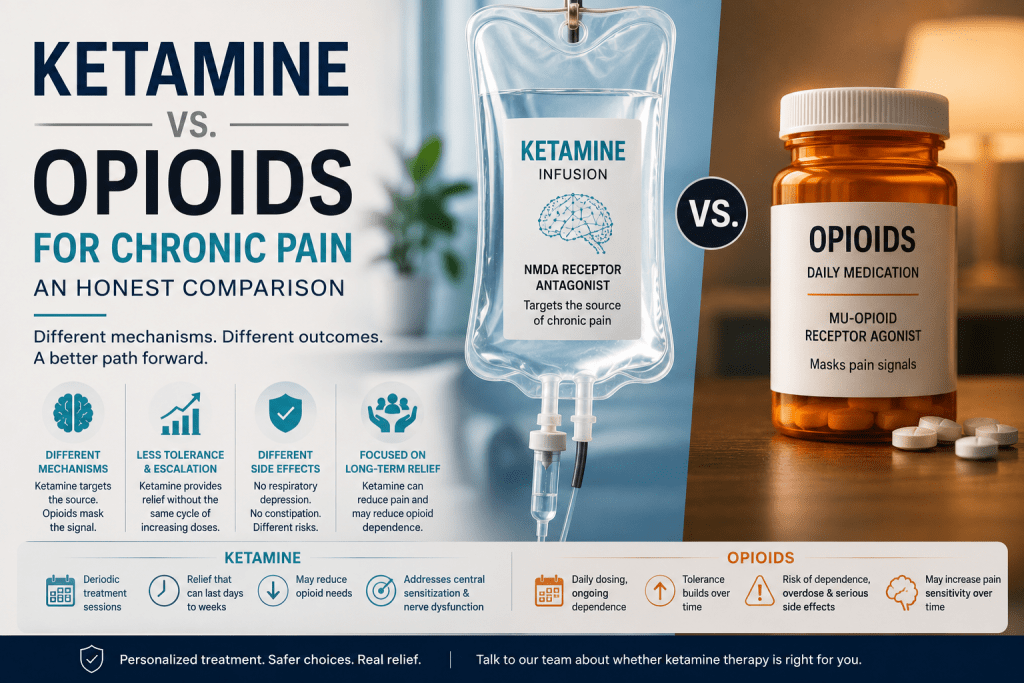
Opioids and ketamine treat pain through completely different mechanisms. Opioids bind to opioid receptors and dampen the pain signal. Ketamine blocks NMDA receptors, which are involved in the process that makes chronic pain self-sustaining. The practical difference is that opioids require ongoing daily dosing and build tolerance over time, while ketamine is given in periodic infusions and can sometimes reduce the amount of opioid a patient needs. Ketamine does not cause respiratory depression at the doses used for pain, does not cause constipation, and carries a different dependency profile. It is not a replacement for opioids in every case, and it does not work for everyone. But for patients who have been on escalating opioid doses with diminishing benefit, it represents a genuinely different approach rather than another version of the same one.
The Conversation Nobody Prepares You For
There is a specific moment that a lot of chronic pain patients recognize. You are in an exam room, and the doctor is looking at your chart, and you can feel the temperature of the conversation change. You have been on opioids for a while. The dose has crept up. It is working less than it used to. And now the question hanging in the air is not “how do we treat your pain” but “how do we get you off this.”
Nobody in that room is the villain. The physician is worried about your safety and about prescribing patterns that have been scrutinized heavily since the CDC issued its opioid guidelines. You are worried that the one thing keeping you functional is about to be taken away. Both of you are responding to something real.
What often gets lost is the third option, which is that there may be treatments that address your pain through a mechanism entirely unrelated to opioid receptors. Ketamine is one of them.
How Each One Actually Works
The mechanisms matter here, because they explain almost every practical difference that follows.
Opioids attach to opioid receptors in the brain, spinal cord, and gut. When they bind, they reduce how strongly pain signals are perceived. The signal is still being sent. Your brain just receives it more quietly. This is why opioids work quickly and why they work across so many different pain types.
Ketamine blocks NMDA receptors. These receptors are heavily involved in central sensitization, the process by which the nervous system essentially learns to be in pain. In sensitized states, the spinal cord amplifies incoming signals and the brain keeps generating pain output even when the original injury has healed. Ketamine interferes with that amplification.
The distinction in plain terms: opioids turn down the volume on a signal that keeps playing. Ketamine goes after the mechanism that keeps turning the volume back up.
Tolerance and Escalation
This is where the two diverge most sharply, and it is what patients feel first in their own bodies.
Opioid tolerance is well documented. Over months and years, the same dose produces less relief, and doses tend to climb. There is also a recognized phenomenon called opioid-induced hyperalgesia, in which long-term opioid use can actually increase sensitivity to pain. Patients who experience it describe pain that has spread beyond its original location and become harder to pinpoint.
Ketamine works differently in this respect. It is given in periodic infusions rather than daily doses, and relief often persists between sessions rather than requiring continuous presence of the drug. Tolerance to ketamine’s pain effects can develop with very frequent use, which is one reason protocols space sessions out rather than running them constantly.
There is also evidence that ketamine can partially reverse opioid tolerance, which is why it is sometimes used specifically to help patients on high doses reduce them. If you want to understand more about how the infusion process works in practice, our page on ketamine therapy covers the protocol in detail.
Side Effects Compared Honestly
Neither of these is a benign medication. The differences are in what kind of burden they place on you.
Opioids commonly cause constipation, which is persistent and does not improve with time. Also sedation, mental fog, nausea, itching, reduced testosterone and other hormonal effects with long-term use, and at higher doses, respiratory depression. Respiratory depression is the mechanism behind opioid overdose deaths.
Ketamine causes dissociation during the infusion, which most people describe as floating or feeling detached. It raises blood pressure and heart rate during the session. It commonly causes nausea, dizziness, and blurred vision. Some patients feel groggy or emotionally raw for the rest of the day. At the doses used for chronic pain, it does not cause respiratory depression. Long-term frequent use, particularly at recreational doses far above therapeutic ones, has been associated with bladder problems and cognitive effects.
The most meaningful practical difference: opioid side effects are with you every day because the medication is with you every day. Ketamine side effects are concentrated into the infusion day and largely resolve by the next morning.
The Dependency Question
Both carry risk. Pretending otherwise would be dishonest.
Physical dependence on opioids develops in most patients on long-term therapy. That is not the same as addiction, but it does mean stopping abruptly produces genuine withdrawal, and it means you are tethered to a prescription and a refill schedule.
Ketamine has abuse potential and is a controlled substance. Recreational misuse is well documented. In a clinical setting with physician-administered infusions and no take-home medication, that risk profile changes considerably, because you are not in possession of the drug and dosing is not in your hands.
A history of substance use disorder does not automatically disqualify you from ketamine, but it is something your physician needs to know about so monitoring can be adjusted.
Where Ketamine Has the Strongest Evidence
Ketamine is not equally useful across all pain. The evidence is strongest for neuropathic and centrally sensitized pain.
The condition with the most supportive data is complex regional pain syndrome, where consensus guidelines have found the evidence stronger than for most other chronic pain diagnoses. Other conditions where it is commonly considered include diabetic neuropathy, post-herpetic neuralgia, phantom limb pain, persistent post-surgical pain, and refractory pain in patients with significant opioid tolerance.
For pain with a clear structural cause, ketamine is usually not the right first move. If a nerve root is compressed, the more direct answer is often an epidural steroid injection or a microdiscectomy. If the sacroiliac joint is the driver, a sacroiliac joint injection or SI joint fusion targets the source. Conditions like sciatica, spinal stenosis, sacroiliac joint pain, and arthritis usually respond better to treatments aimed at the mechanical problem.
The Practical Realities
This comparison would be incomplete without the parts that affect your actual life.
Access. Opioids come from a pharmacy in a bottle. Ketamine requires you to travel to a clinic, sit for an infusion, and arrange a ride home. For someone working full time in the city, that is real logistical friction.
Cost. Generic opioids are inexpensive and usually covered. Ketamine for chronic pain is used off-label, which means the FDA approved ketamine as an anesthetic rather than specifically for chronic pain. Off-label prescribing is legal and common throughout medicine, but insurers frequently decline coverage. Ask about the cost of a full series before you start, not after.
Time commitment. An initial ketamine series typically runs several sessions across a few weeks, followed by maintenance infusions. That is more time out of your schedule than picking up a prescription.
Predictability. Opioids work reliably and immediately, which is part of why they are so widely used. Ketamine response varies. Some patients get substantial relief, some get modest relief, and some get very little.
It Is Often Not Either-Or
The framing of ketamine versus opioids is useful for understanding the differences, but real treatment plans are rarely that clean.
Many patients continue opioid therapy at a reduced dose while receiving periodic infusions. The goal in those cases is not necessarily zero opioids. It is a lower, more stable dose with better function and fewer daily side effects. That is a legitimate outcome.
Ketamine is also frequently one piece of a larger plan. Physical therapy often becomes possible during the relief window when pain has quieted enough to move. And for patients whose infusion relief is real but short-lived, a spinal cord stimulator or peripheral nerve stimulation can provide continuous relief without repeat clinic visits. Some patients with structural contributors also benefit from procedures like Minuteman lumbar fusion.
What This Means If You Are Currently on Opioids
A few things are worth saying directly.
Do not taper on your own. Abrupt reduction produces withdrawal and often a sharp pain flare, and it is dangerous.
You are not failing at anything by being on opioids. You were prescribed a medication for a legitimate condition and you took it as directed.
Being interested in alternatives is not an admission that your pain was never real. It usually means the tradeoffs have shifted and you want to look at other options.
And if a physician has raised the idea of tapering, ask what the replacement plan is. “Reduce your dose” without an accompanying strategy is not a treatment plan.
Getting a Real Assessment in New York City
Whether ketamine makes sense for you depends on your diagnosis, your history, your current medications, and what you have already tried. That is not something an article can settle.
Our interventional pain physicians evaluate each patient individually, and if ketamine is not a good fit, we will tell you that and explain what we would recommend instead.
Schedule a consultation to talk through your options honestly.