TLDR
Coming off opioids for chronic pain is possible, and for many people it leads to better pain control rather than worse. Long-term opioid use often stops working over time because the body builds tolerance, and in some cases opioids can actually increase pain sensitivity. The safe way off is a gradual taper planned with your doctor, never an abrupt stop, which can cause severe withdrawal and a sharp pain flare. The good news is that a wide range of non-opioid options exists, including interventional procedures like injections and nerve treatments, physical therapy, non-opioid medications, and behavioral health support for the very real mental side of chronic pain. National guidance from the CDC now recommends non-opioid treatments as the preferred starting point for most chronic pain. If a doctor wants to reduce your opioids, the right question to ask is what the replacement plan is, because reducing a dose without a real alternative is not a treatment plan.
If You Are Reading This, You Are Not Failing
Let us start here, because it matters. If you are on opioids for chronic pain and thinking about getting off them, you have not done anything wrong. You were prescribed a medication for a real condition and you took it as directed. Millions of people are in the same position, largely because for years opioids were prescribed as a front-line answer for chronic pain before the long-term picture was well understood.
So set the guilt aside. The question in front of you is practical: your current approach may not be serving you well anymore, and there are alternatives that can. Let us walk through why opioids often stop working, how to come off them safely, and what actually replaces them.
Why Long-Term Opioids Often Stop Working
Opioids are genuinely effective for short-term and acute pain. The trouble is what happens over months and years.
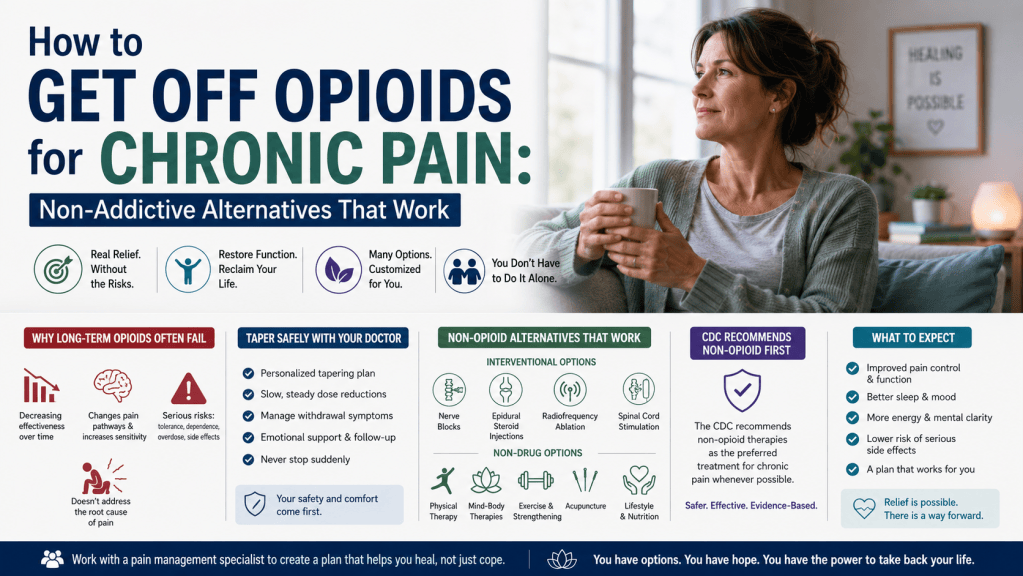
Tolerance. Your body adapts to opioids, so the same dose produces less relief over time. This is why doses so often creep upward, chasing a level of relief that keeps receding.
Opioid-induced hyperalgesia. This is the counterintuitive one. In some people, long-term opioid use actually increases sensitivity to pain. The medication meant to reduce your pain can, over time, contribute to it. Patients experiencing this often describe pain that has spread beyond its original location and become harder to pinpoint, and they sometimes find that reducing opioids paradoxically improves their pain.
Daily side effects. Long-term opioids bring a steady load of constipation that does not improve with time, mental fog, fatigue, hormonal changes, and disrupted sleep. These accumulate quietly and shrink your quality of life in ways that are easy to stop noticing until they lift.
None of this means opioids are evil or that you were foolish to take them. It means that for chronic, long-term pain, they often deliver diminishing returns while extracting a rising cost.
What the CDC Actually Recommends Now
The national conversation around opioids has shifted, and it helps to know where the guidance actually stands.
The CDC’s guideline on prescribing opioids for pain recommends that for most chronic pain, non-opioid therapies are preferred as the starting point, with opioids used only when their expected benefits are likely to outweigh their risks, and typically alongside non-opioid approaches rather than instead of them. You can read the current framework in the CDC’s Clinical Practice Guideline for Prescribing Opioids for Pain.
One important nuance, which the CDC itself has stressed: this guidance is not a mandate to force rapid tapers or to cut off patients already on long-term opioids. Abrupt, involuntary reductions can cause real harm. The point is a more thoughtful approach, not an abrupt one. If your care is being handled well, non-opioid options are brought in as opioids are carefully reduced, so you are never left with nothing.
How to Taper Safely: The Rules That Matter
This is the part to take most seriously. Coming off opioids is done gradually and with medical supervision, never on your own and never all at once.
Never stop abruptly. Suddenly stopping opioids after long-term use can cause severe withdrawal, including nausea, muscle pain, anxiety, insomnia, and a sharp rebound in your original pain. It can also be dangerous. A taper avoids this by stepping the dose down slowly enough for your body to adjust.
Taper on a plan, with your doctor. A good taper is individualized. The speed depends on how long you have been on opioids, your dose, and how you respond at each step. Some tapers unfold over weeks, others over many months. Slower is often better, and a good clinician will pause or adjust the pace based on how you are doing rather than pushing a fixed schedule.
Expect the plan to include pain management, not just dose reduction. This is the crucial part. A taper should run alongside a real strategy for controlling your pain through other means, which is the whole subject of the next section. Reducing your opioids without building in alternatives is not a treatment plan, and you are within your rights to ask what the alternative is.
Speak up as you go. Tapering is not a test of toughness. If a step is too hard, that is information for your doctor, not a failure on your part. The pace can be adjusted.
The Non-Opioid Alternatives That Actually Work
Here is the reassuring part. “Getting off opioids” does not mean “living with untreated pain.” A broad toolkit exists, and for many people a combination of these works better than opioids did.
Interventional procedures. This is where a dedicated pain practice earns its keep. Rather than dampening pain signals throughout your whole body the way opioids do, these procedures target the specific source of your pain. Depending on your diagnosis, that can include steroid injections around irritated nerves, nerve blocks, radiofrequency ablation that quiets specific pain-carrying nerves, and other targeted treatments. For joint-driven pain, options like knee injections can deliver focused relief right where the problem is.
Non-opioid medications. Several medication classes treat pain through mechanisms that do not carry opioid dependency, including certain nerve-pain medications, some antidepressants used specifically for pain, anti-inflammatories, and topical treatments. These are chosen based on the type of pain you have.
Physical therapy and movement. For most chronic pain, targeted movement is not optional background advice, it is core treatment. A structured program builds the strength and mobility that reduce pain at its mechanical source, and unlike a pill, its benefits compound over time.
Behavioral health support. Chronic pain is exhausting, isolating, and demoralizing, and coming off opioids adds its own stress. This is not a matter of pain being “in your head.” It is that the brain’s processing of pain is genuinely influenced by stress, sleep, and mood, and addressing those changes how pain feels. Support through behavioral health care, including approaches like cognitive behavioral therapy, has real evidence behind it for chronic pain and can make the whole transition more manageable.
Lifestyle and nutrition. Anti-inflammatory eating, better sleep, and gradual reconditioning all move the needle. None of them is a magic fix on its own, but together they change the baseline you are working from. Support with nutrition can be a practical piece of the plan.
The strength of this approach is that it is layered. No single alternative has to fully replace opioids, because several working together often outperform what opioids were doing alone.
What to Expect During the Transition
Honesty helps here, so a realistic picture.
The early phase can be the hardest, as your body adjusts to lower doses and the alternative treatments are still ramping up. You may have some rough days. This is expected and temporary, and it is exactly why the process is medically supervised and paced to you.
Many people find that as opioids come down and other treatments take hold, their pain control holds steady or improves, their mental clarity returns, the constipation and fog lift, and their sleep gets better. Patients who experienced opioid-induced hyperalgesia sometimes notice their pain actually decreasing as the opioids decrease, which surprises them.
It is not instant and it is not always smooth. But the direction of travel, for most people who do this with good support, is toward better function rather than worse.
The Question to Ask Your Doctor
If a physician suggests reducing your opioids, do not just hear the reduction. Ask the follow-up that matters: “What is the plan for managing my pain as we do this?”
A good answer describes specific alternatives, a realistic pace, and a way to adjust if things get hard. A poor answer is just a lower number with nothing behind it. You deserve the first kind, and a pain practice built around interventional and whole-person care is designed to provide it.
Getting Off Opioids With Real Support in NYC
Coming off opioids is not something to do alone, white-knuckling through withdrawal and hoping the pain stays manageable. Done properly, it is a supervised transition onto treatments that target your pain at its source, backed by a team that adjusts the plan to you.
Our pain management approach is built around exactly this: reducing reliance on opioids while replacing them with targeted, effective alternatives, so you end up with better pain control and fewer daily costs, not a lower dose and more suffering.
If you want off opioids and want a real plan for your pain, reach out to schedule a consultation and start building one.