
TLDR:
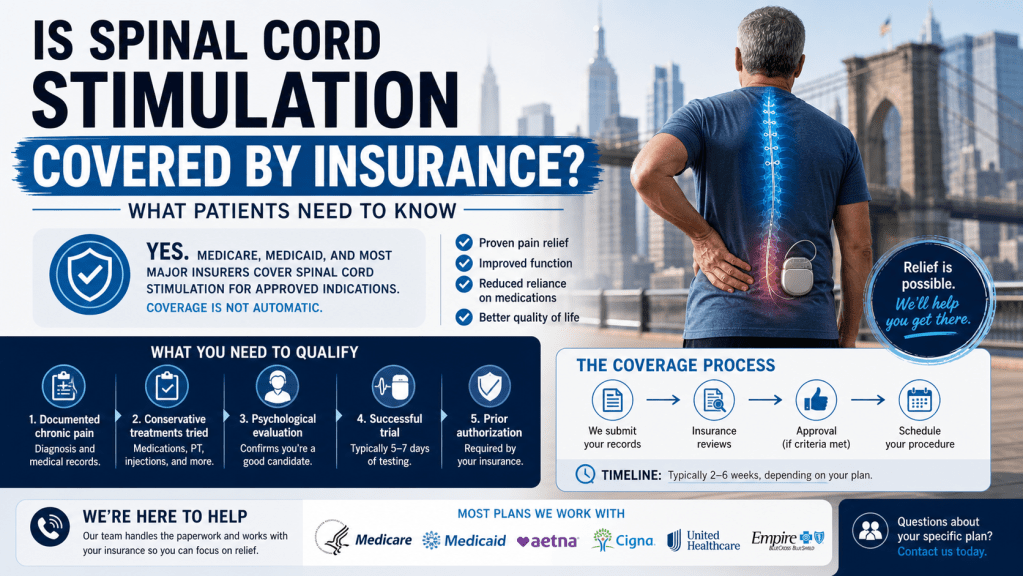
Spinal cord stimulation is covered by Medicare and most major commercial insurance plans for patients who meet specific criteria. Coverage is not automatic. You need documented proof that conservative treatments have failed, a successful trial, and often a psychological evaluation. Prior authorization is required. The process takes time but is manageable, and our team can help you navigate it.
This is one of the first questions patients ask, and it is a fair one. Spinal cord stimulation involves a device, a procedure, and ongoing management. Before any of that conversation goes further, patients want to know whether they are looking at a bill they cannot pay.
The short answer is that for patients who meet the clinical criteria, coverage is generally available. The longer answer involves understanding what insurers actually require, because the process is not automatic and it is not fast.
Does Medicare Cover Spinal Cord Stimulation?
Yes. Medicare covers spinal cord stimulation as a treatment for chronic pain when specific criteria are met.
Medicare requires that the patient has had chronic pain for at least six months, that conservative treatments including medications and other interventional options have been tried and have not provided adequate relief, that the patient passes a psychological or psychiatric evaluation, and that a successful trial is completed before the permanent implant is approved.
The trial and the permanent implant are billed and covered as separate procedures. Coverage applies to both, provided the documentation supports medical necessity at each stage.
If you are on Medicare Advantage, coverage rules follow Medicare guidelines but may include additional plan-specific requirements. It is worth confirming directly with your plan before proceeding.
What About Commercial Insurance?
Most major commercial insurers, including Aetna, Cigna, UnitedHealthcare, and Blue Cross Blue Shield plans, cover spinal cord stimulation for approved indications. The criteria are similar to Medicare in most cases.
Insurers typically want to see:
Documented failure of conservative treatment. This means your records show that you have tried physical therapy, medications, and often one or more interventional procedures like epidural steroid injections or other targeted treatments, without adequate relief. Exactly what counts as sufficient prior treatment varies by insurer and by your diagnosis.
A qualifying diagnosis. Coverage is tied to specific conditions. Chronic pain from failed back surgery syndrome, sciatica that has not responded to other treatment, complex regional pain syndrome, and spinal stenosis are among the most commonly covered indications. Conditions like sacroiliac joint pain may require additional documentation depending on your insurer.
A psychological evaluation. Most insurers require this before approving the trial. It is not a test you pass or fail in the way patients sometimes fear. It is an assessment of whether SCS is likely to be effective for you and whether you have realistic expectations about what the therapy can do. Patients with untreated depression, active substance use disorders, or significant psychological barriers to treatment may need those issues addressed first.
A successful trial. The insurer will not approve the permanent implant without confirmation that the trial produced meaningful relief. Most plans use 50% or greater pain reduction as the benchmark.
What Is Prior Authorization and Why Does It Matter?
Prior authorization means your insurer reviews the clinical evidence for your specific case and approves coverage before the procedure happens. Without it, you are not covered.
This step requires your physician to submit documentation: your diagnosis, your treatment history, the clinical rationale for SCS, and supporting records. The process takes time. Approvals can take anywhere from a few days to several weeks depending on the insurer and whether additional information is requested.
Denials happen. When they do, the right response is usually to appeal with additional documentation, not to assume the answer is final. A significant portion of initial denials are overturned on appeal when the clinical record is complete and clearly presented.
Our team manages this process for patients. You should not have to figure out what documentation is needed or navigate the insurer’s portal on your own.
What Is Not Typically Covered
There are situations where coverage is less straightforward or not available.
If your diagnosis does not fall within the approved indications for your plan, coverage may be denied regardless of how much pain you are in. Some newer stimulation technologies or device models may have more limited coverage than established ones, even if the clinical evidence supports them.
Patients who have not completed a sufficient course of conservative treatment before requesting SCS authorization will generally be denied. Insurers want to see that less invasive options have been tried first. Jumping straight from a new pain diagnosis to a stimulator request will not get through prior authorization.
Cosmetic or lifestyle-driven requests are not covered. SCS is a treatment for medically documented chronic pain, and it is approved on that basis.
Does Medicaid Cover Spinal Cord Stimulation?
Medicaid coverage varies significantly by state. Some state Medicaid programs cover SCS under specific circumstances, others do not. If you are on Medicaid, this needs to be verified directly for your state and your plan. We can help with that conversation.
What If I Do Not Have Insurance?
This is a harder situation, and it deserves a direct answer rather than a runaround.
Spinal cord stimulation without insurance coverage is expensive. Device costs, facility fees, physician fees, and follow-up care add up to a number most patients cannot absorb out of pocket.
If you are uninsured or underinsured, options worth exploring include patient assistance programs offered by device manufacturers, which some companies provide for patients who meet income criteria. Qualifying for coverage through Medicaid, if you are eligible, is another avenue. Some patients pursue coverage through the ACA marketplace if they are in an enrollment window.
We are not going to pretend there is an easy path here for uninsured patients, because there often is not. But we can have a real conversation about your situation and what options exist. Reach out to us and we will tell you what we know.
How to Strengthen Your Case for Coverage
If you are planning to pursue SCS and want your authorization to go through cleanly, a few things help.
Keep records of everything you have tried. Every medication, every injection, every course of physical therapy. Dates, providers, outcomes. Insurers want a clear timeline showing that other options were pursued seriously before arriving at SCS.
Be consistent in how you describe your pain to your physicians. Inconsistencies in the record between visits can raise questions during authorization review.
Follow through on the psychological evaluation without delay. Patients sometimes put this off because it feels like an obstacle. It is actually one of the requirements most within your control to complete quickly, and it unblocks the rest of the process.
Work with a physician practice that handles prior authorization routinely. The documentation requirements are specific, and practices that do this regularly know what insurers want to see.
Which Conditions Qualify
Coverage is tied to diagnosis, so it is worth knowing where SCS sits within your treatment picture.
Patients with chronic pain from failed back surgery, sciatica that has not resolved with other treatment, CRPS, and spinal stenosis have the strongest documented evidence base for SCS and the most consistent coverage across plans.
For patients whose pain involves sacroiliac joint dysfunction, peripheral nerve stimulation may be a more appropriate and separately covered option worth discussing alongside SCS.
For patients with arthritis-related chronic pain, the picture is more varied. SCS is not a first-line treatment for arthritis, but for patients with significant neuropathic components who have exhausted other options, it may be worth an evaluation.
The Bottom Line
Insurance coverage for spinal cord stimulation is real and available for patients who meet the criteria. It is not a rubber stamp process, and it requires documentation, patience, and often a back-and-forth with the insurer. But for patients who are genuinely candidates for this therapy, the coverage path exists.
If you want to understand whether you are likely to qualify based on your diagnosis and treatment history, the best starting point is a conversation with us. We can review your situation, tell you where you stand, and manage the authorization process if you decide to move forward.
Contact Maywell Health to get started, or learn more about what we treat at Maywell Health.