
TLDR
Pain near your lower back or buttocks does not automatically mean a spine problem. Here is what to know right now:
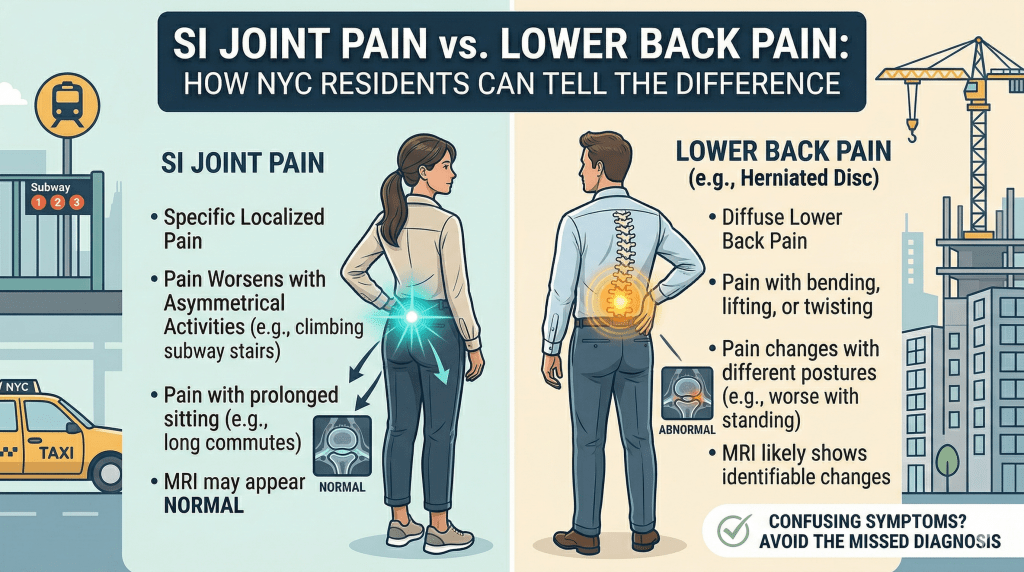
- SI joint pain is almost always one sided, near the lower back dimples, and rarely travels below the knee
- Lower back pain from the spine often shoots down the leg, past the knee
- A normal MRI does not rule out SI joint dysfunction, this is the most common reason it gets missed
- Climbing subway stairs, sitting on hard plastic seats, and standing on a moving train are classic SI joint triggers
- The most reliable way to confirm SI joint pain is a targeted diagnostic injection, not imaging
- Up to 30% of chronic lower back pain cases are actually SI joint pain in disguise
If you have been told your MRI is normal but you are still in pain every time you climb subway stairs or sit through a long commute, you are not imagining it. SI joint dysfunction is one of the most commonly missed diagnoses in chronic lower back pain, and the physical demands of daily life in New York City make it even more likely to develop and go undetected.
Here is how to understand what is actually going on.
Why NYC Life Is Hard on the SI Joint
The sacroiliac joint sits where your spine meets your pelvis, one on each side, right at the dimples of your lower back. Its job is to absorb shock and transfer load between your upper body and legs every time you move.
Now think about what a typical NYC day looks like:
- Standing on a swaying subway car, constantly engaging your core and pelvis to stay balanced
- Sitting on hard plastic seats that push your pelvis into a poor position
- Climbing stairs at subway stations, which can load lower extremity joints at 6 to 8 times your body weight
- Walking miles on concrete that offers zero shock absorption
Each of these is a direct mechanical stressor on the SI joint. For roughly 15 to 30% of people with chronic lower back pain, the SI joint is the actual pain source, not the spine.
What SI Joint Pain Actually Feels Like
Patients often describe it as a deep, dull ache, almost like a toothache, located near one side of the lower back or buttock. Key characteristics:
- Almost always one sided
- Centered near the lower back dimples or the top of the buttock
- Can refer into the groin or upper thigh
- Rarely travels below the knee
- Worsens when climbing stairs, sitting for long periods, rolling over in bed, or standing on one leg
That last point is a classic NYC tell. If your pain flares every time you stand on one foot to get dressed or step onto a crowded train, the SI joint is worth investigating.
What Lower Back Pain From the Spine Feels Like
Lumbar spine pain typically comes from discs, nerves, or vertebral joints. The pattern is different:
- Often feels more central or spreads across both sides of the lower back
- Shooting or burning pain that travels below the knee, sometimes to the calf or foot
- Worsens with bending forward, lifting, or prolonged standing
- Often accompanied by numbness, tingling, or weakness in the leg
| Feature | SI Joint Pain | Lumbar Spine Pain |
| Location | One sided, near lower back dimples | Central or bilateral lower back |
| Leg pain | Buttock and upper thigh only | Below the knee, into calf or foot |
| Worst trigger | Stairs, sitting, rolling in bed | Bending, lifting, prolonged standing |
| MRI findings | Often normal | Usually shows disc or nerve changes |
| Side affected | Almost always one side | Can be one or both sides |
Why SI Joint Pain Gets Missed So Often
This is the part that frustrates most patients. Standard MRI is excellent at showing disc problems and nerve compression but frequently misses SI joint dysfunction. Patients spend months or even years being treated for a lumbar spine problem that was never actually there.
The diagnostic process for SI joint pain relies on physical examination and hands on tests, not imaging alone. Doctors use specific maneuvers to stress the joint and recreate your familiar pain:
- Thigh Thrust Test: Downward pressure through the thigh, the most sensitive test for SI joint dysfunction
- Distraction Test: Outward pressure on the front of the pelvis, highly specific for SI joint irritation
- Compression Test: Squeezing the pelvis in a side lying position
- FABER Test: Moving the leg into a figure four position to stress the hip and SI joint
- Gaenslen’s Test: Stressing the joint through rotational force
If three or more of these tests reproduce your familiar pain, SI joint involvement is very likely regardless of what your MRI shows.
The Gold Standard: Diagnostic Injection
The most reliable way to confirm SI joint pain is a sacroiliac joint steroid injection using a local anesthetic. If the injection significantly reduces your pain, it confirms the SI joint as the source. This single test does what no scan can: it tells you exactly where the pain is coming from.
For NYC patients navigating multiple specialists and conflicting opinions, this diagnostic clarity is often the turning point after years of uncertainty.
Who Is Most at Risk in NYC
SI joint dysfunction does not affect everyone equally. Higher risk groups include:
- Women during or after pregnancy, hormonal changes loosen pelvic ligaments significantly
- Patients who have had prior lumbar spine surgery, which shifts extra load onto the SI joint
- Daily commuters who spend long periods standing on moving trains or sitting on hard surfaces
- People who walk several miles daily on concrete without supportive footwear
- Anyone with a leg length discrepancy, which creates uneven pelvic loading with every step
What to Do If This Sounds Like You
If your lower back or pelvic pain has lasted more than 6 weeks, is consistently one sided, and has not responded to treatment aimed at your spine, ask specifically about the SI joint.
A proper physical examination using targeted provocative tests, followed by a diagnostic injection if needed, can give you a clear answer quickly. You do not need to keep guessing.
The team at Maywell Health specialises in diagnosing and treating sacroiliac joint pain with a thorough, patient first approach that goes beyond what a standard MRI can show.
Contact Maywell Health to get a proper evaluation and finally understand where your pain is actually coming from.