
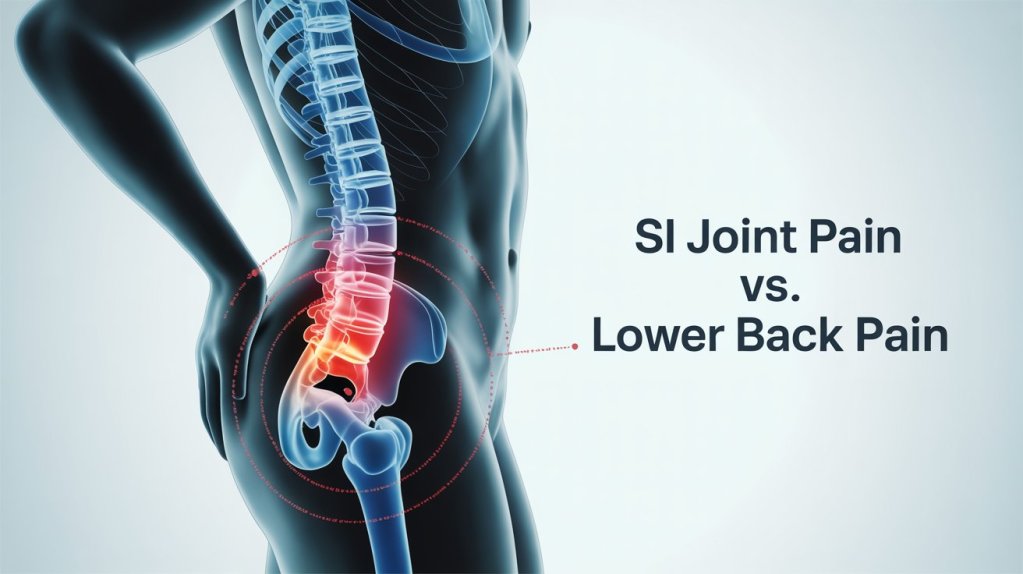
TLDR: SI joint pain and lower back pain feel very similar but come from different sources. SI joint pain is usually one-sided, near the beltline or buttock, and does not travel below the knee. Lower back pain often involves the spine, discs, or nerves and can shoot down the leg. Getting the right diagnosis is the key to getting the right treatment.
If you have been living with pain in your lower back, hips, or buttocks, you already know how exhausting it is to search for answers. One of the most common and frustrating situations patients face is not knowing whether their pain is coming from the spine or from the SI joint. Both feel similar, both sit in roughly the same area, and both are often dismissed or misdiagnosed for months.
This guide is written to help you understand the difference clearly, without confusing medical language.
What Is the SI Joint and Why Does It Hurt?
The sacroiliac joint sits where your spine meets your pelvis, one joint on each side of your lower back. You can feel the general area by pressing on the small dimples just above your buttocks. This joint does a quiet but important job: it absorbs shock and transfers load between your upper body and legs every time you walk, stand, or climb stairs.
When this joint becomes inflamed, too stiff, or moves abnormally, it causes pain that is surprisingly easy to confuse with a spine problem. Sacroiliac joint pain is more common than most people realise, and it is frequently underdiagnosed because standard MRI scans often miss it.
What Causes Lower Back Pain?
Lower back pain typically comes from the lumbar spine, the five vertebrae in your lower back, along with the discs between them and the nerves that travel through them. Common causes include:
- Herniated or bulging discs
- Lumbar muscle strain or sprain
- Degenerative disc disease
- Spinal stenosis (narrowing of the spinal canal)
- Sciatica from nerve compression
These are structural or nerve-related problems, and the treatment approach is very different from SI joint dysfunction.
The Symptom Overlap That Confuses Everyone
Here is the honest truth: both conditions cause pain in the same general region. That is why so many patients spend months on treatments that do not work, because the wrong source is being treated. The details of your pain, however, tell a different story.
Location of Pain
SI joint pain is almost always felt on one side only, right at or just below the beltline, often spreading into the buttock or upper thigh. Lower back pain tends to feel more central or bilateral and spreads across the lumbar region.
Does It Travel Down the Leg?
This is one of the most useful clues. SI joint pain can refer into the buttock, groin, or upper thigh, but it rarely travels below the knee. Sciatica from a lumbar disc issue typically shoots below the knee, sometimes reaching the calf or foot.
What Makes It Worse?
|
Trigger |
SI Joint Pain |
Lumbar Back Pain |
| Sitting for long periods | Yes, commonly | Sometimes |
| Climbing stairs | Yes, often | Occasionally |
| Standing on one leg | Yes, frequently | Rarely |
| Bending forward | Occasionally | Very commonly |
| Rolling over in bed | Yes, very common | Sometimes |
| Lifting heavy objects | Occasionally | Very commonly |
Which Side?
SI joint problems are almost always one-sided. Lumbar disc issues can be one-sided or affect both sides.
How Doctors Diagnose SI Joint Pain vs. Lumbar Pain
Physical Examination Tests
Doctors use specific hands-on tests to stress the SI joint and recreate your pain. Common ones include:
- FABER Test: Your leg is moved into a figure-four position to compress the SI joint
- Thigh Thrust Test: Pressure applied through the thigh stresses the SI joint
- Distraction and Compression Tests: Stress applied directly to the pelvis
If three or more of these tests reproduce your familiar pain, SI joint involvement is very likely.
For lumbar causes, doctors check for nerve signs such as reflex changes, leg weakness, and a positive straight-leg raise test.
Imaging
MRI is excellent for identifying disc problems, nerve compression, and spinal abnormalities. However, it is important to understand that SI joint dysfunction does not always appear on standard MRI. A normal scan does not mean there is no problem.
Diagnostic Injection
The most reliable way to confirm SI joint pain is a sacroiliac joint steroid injection with local anesthetic. If the injection significantly reduces your pain, it confirms the SI joint as the source. This is both a diagnostic tool and a treatment in one.
Common Misconceptions Patients Have
“My MRI was normal, so nothing structural is wrong.”
SI joint dysfunction frequently does not appear on routine MRI. Many patients with significant SI joint pain have completely normal imaging.
“Pain on one side must be sciatica.”
True sciatica travels below the knee. If your pain is concentrated in the buttock, hip, or upper thigh on one side, the SI joint is a strong candidate.
“Only elderly people get SI joint problems.”
Young adults, women during or after pregnancy, athletes, and patients who have had prior lumbar fusion surgery are among the most common groups affected.
“Back pain always means a spine problem.”
Up to 25% of people diagnosed with chronic lower back pain may actually have SI joint dysfunction as the primary or contributing source.
When to See a Specialist
Consider consulting a spine or pain specialist if:
- Your lower back or pelvic pain has lasted more than 6 weeks
- Pain is disrupting your sleep, work, or daily activities
- You have tried rest and over-the-counter pain relief without meaningful improvement
- Your pain is consistently one-sided and located near the lower back dimples
- Previous treatments for lumbar back pain have not helped
Maywell Health specialises in diagnosing and treating both SI joint dysfunction and lumbar spine conditions with a patient-first approach.
Treatment Paths Are Very Different
This is the core reason why getting the diagnosis right matters so much. Treating a lumbar disc problem with SI joint exercises will not help. Treating SI joint dysfunction with lumbar epidural injections will not help either.
SI joint treatment may include targeted physical therapy, SI joint injections, and in appropriate cases, sacroiliac joint fusion for patients with confirmed instability who have not responded to conservative care. Lumbar pain treatment follows a completely separate path involving disc-targeted therapy, nerve blocks, or spinal procedures depending on the cause.
Getting the right diagnosis is not just a formality. It is what determines whether your treatment actually works.
Ready to Get Clarity on Your Pain?
If you have been going back and forth between diagnoses without real answers, a proper evaluation can finally point you in the right direction. Contact Maywell Health to speak with a specialist who will take the time to understand your full picture, not just your scan.